

April 24, 2026
10 Minutes



Businesses are paying to reach customers on multiple platforms, all while neglecting the one app they check almost every hour.
Most South African business owners use WhatsApp dozens of times a day. They use it to communicate with family, follow news groups, and stay on top of work conversations. Yet when it comes to marketing their own business, many of them default to platforms they’re less comfortable with — Facebook and Instagram ads that don’t convert, email campaigns that land in spam, or posts that reach a fraction of their target audience.
Meanwhile, they’re sitting on one of the most powerful direct marketing channels available in South Africa. And let’s be honest, most people aren’t using it intentionally at all.
WhatsApp has 96% penetration among South African internet users — higher than any other social platform in the country. Globally, messages sent to opted-in contacts achieve a 98% open rate and click-through rates of 45–60% on promotional content. For context, a good email campaign in South Africa gets a 20% open rate on a good day.
This article is the practical guide to using WhatsApp as an intentional marketing channel — not just a reactive inbox.
In many markets, WhatsApp is one messaging option among several, but in South Africa, it’s the default. It’s where people coordinate school pickups, share family news, run community groups, and increasingly, where customers are communicating with businesses.
According to Meltwater’s 2025 South Africa Digital Report, WhatsApp ranks as the number one social media platform in SA, with 93.8% of South African internet users aged 16 and above using the platform. The average South African spends nearly 25 hours a month on the platform. That’s not a casual audience. That’s where a lot of your customers are living.
This matters for marketing because trust often transfers. When a customer receives a WhatsApp message from your business, it lands in the same environment where they talk to their friends and family. That context creates a certain level of intimacy that would be difficult to replicate elsewhere — but it also means that the relevance of your communication with the client must be higher. Send something irrelevant or intrusive, and you’ll get blocked faster than an automated marketing call centre.
Done right, WhatsApp marketing feels like a clear and trustworthy conversation. Done wrong, it feels like spam in someone’s personal space.
This is the question most SA business owners get stuck on. So without over-complicating it, here's the simplified version.
The WhatsApp Business App is free, takes 30 minutes to set up, and is designed for small businesses. It gives you a business profile with your address, hours, and website; a product catalogue; quick reply templates; automated greeting and away messages; and broadcast lists of up to 256 contacts. For most SA SMEs, this is where you should start and it can serve you well long term.
The WhatsApp Business API is for businesses that have outgrown 256 contacts or need automation at scale. It allows unlimited broadcasts, CRM (Customer Relationship Management) integration, chatbot flows, and multi-agent management. However, keep in mind that it’s not free. You pay per message (roughly R0.45–R2.50 depending on the message category and provider), and you’ll need a third-party platform to access it, such as Wassenger, Interakt, or 360dialog.
For more information check out: The Complete 2026 Guide On WhatsApp Business API in South Africa
The practical decision: if your broadcast list is under 256 contacts and you’re managing conversations yourself, definitely start with the free app. When you outgrow it — either in contact volume or in the time it takes to manage manually — then you can begin to explore the API.
One important update worth knowing: WhatsApp very recently enabled Coexistence via Embedded Signup for South Africa. This means you can now run the Business App and the API on the same number simultaneously, which is something that wasn’t possible before. Previously, upgrading to the API meant losing your Business App access entirely, which put many SA businesses off making the move to the API. That barrier is now gone.

Before you send your first broadcast, you need a list of people who have actually agreed to receive messages from you. Keep in mind that this isn’t just good practice — it’s a legal requirement under South Africa’s POPIA (Protection of Personal Information Act).
POPIA requires explicit consent before you send any marketing messages to anyone. Purchasing from you, enquiring via your website, or saving your number does not automatically constitute consent for marketing. You need to ask your contacts permission, and you need to record that they said yes.
The good news is that building an opted-in WhatsApp list is easier than building an email list, because people are already on the platform and the friction to sign up is minimal. Here are some effective ways to grow your list in South Africa:
• Click-to-WhatsApp ads on Facebook and Instagram that ask people to message you for a discount or free resource
• A WhatsApp chat widget on your website with an clear opt-in message built into the greeting
• A simple sign-up form at your till point, market stall, or front desk
• QR codes on packaging, receipts, or in-store signage that open a pre-filled WhatsApp message
• Mentioning your WhatsApp number in your email signature with a clear invitation to opt in
The key thing here is to keep your opt-in record simple: a note of when someone joined your list and how, but just don't lose track!
Note: If you’re using the API with a CRM, this gets tracked automatically.
We find the biggest mistake SA businesses make with WhatsApp broadcasts isn’t sending too many messages — it’s sending the wrong ones. You may think there’s room for error and testing, but here’s the catch: When contacts start reporting or blocking your number, WhatsApp’s algorithm flags you for spam behaviour, and your deliverability can begin to drop across your entire list.
Here is a rule that prevents this: not every message should sell something. A ratio that works well is 2:1. Two value messages for every one promotional message — which is the same principle that underpins any effective social media content strategy. Some value messages might include:
• A genuinely useful tip or news update relevant to your industry
• A behind-the-scenes update or story from your business
• An early heads-up about something coming before it goes public
• A quick poll or question that invites a reply
When you do send a promotional message, be specific. “20% off everything this weekend” performs substantially worse than “Hey there, we’ve got 6 units of [specific product] left at R299 — first come, grab yours while stocks last.” Scarcity and specificity tend to drive action. Generic discount announcements awaken suspicion or uncertainty, and oftentimes can sound spammy.
On frequency: we say one to two broadcasts per week is the cap for most SA audiences before engagement drops and the risk of blocking increases. If you’re not sure, start with one per week and see how your contacts respond. Replies and click-throughs are your signal to do more. Blocks and reports are your signal to pull back and reassess.
Broadcasts are only one part of the picture. The businesses getting the best results from WhatsApp in South Africa are also using it as an active sales channel. There is of course an important structure behind it.
The catalogue feature lets you list your products or services with photos, descriptions, and prices directly inside your WhatsApp Business profile. Customers can browse without leaving the app, which removes friction from the decision to enquire. If you’re not using this yet, set it up today — it takes under an hour and costs nothing.
Quick replies let you save responses to your most common questions as keyboard shortcuts. So if, for example, 80% of your inbound messages ask about pricing, availability, or location, then you can answer them in seconds with a pre-written reply that still feels personal but saves you the time. This solves one of the real pain points a lot of SA business owners run into: customers expect faster responses on WhatsApp in a way they don’t on email, cause they know you're online, and slow replies could cost you sales.
Lead qualification flows are where businesses using the API see the biggest ROI. Instead of every inbound enquiry landing with the same person and getting answered at random, you build a simple flow that asks qualifying questions automatically: what are you looking for? what’s your budget? when do you need it? By the time a user then picks up the conversation, they will already know whether it’s worth pursuing or not.
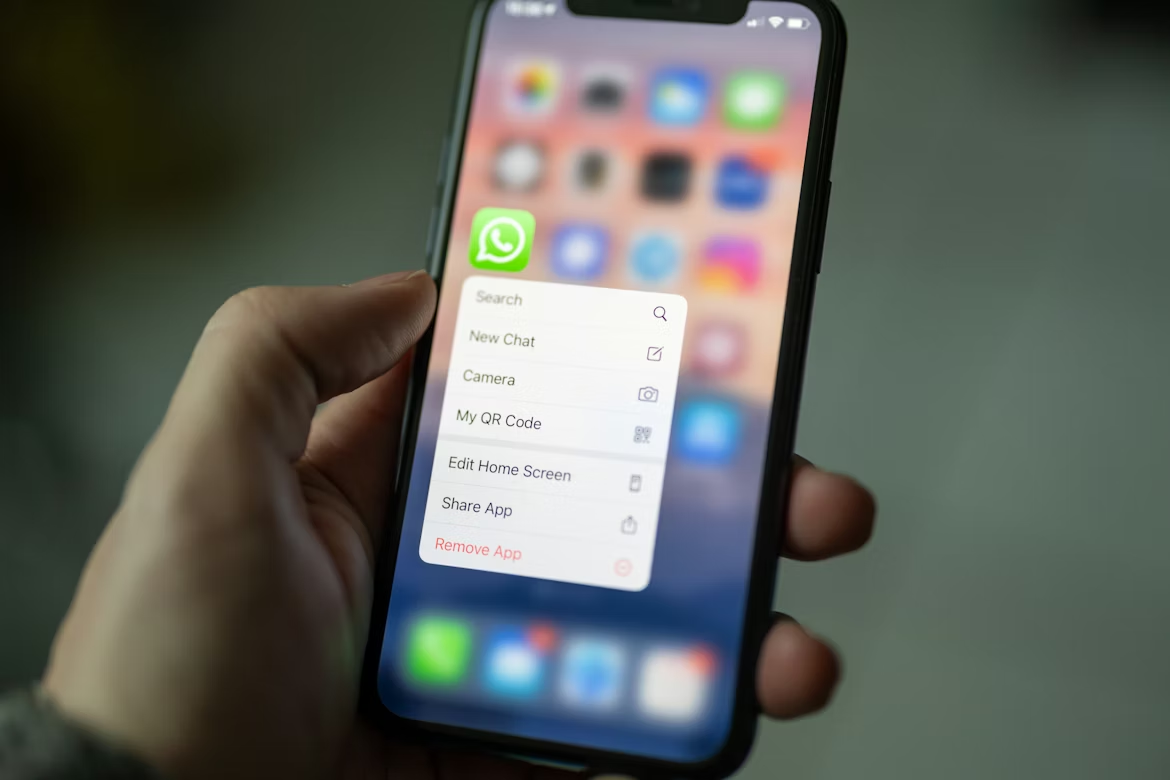
Search for any South African business on WhatsApp and you’ll find the same pattern: you send a message, and it goes into a queue. You wait. Eventually someone responds — sometimes only hours later. These kinds of conversations feel transactional, reactive, and forgettable. It’s one of the main reasons businesses aren’t getting the leads they should online — the channel exists, but there’s too little planning behind using them.
This is what most SA businesses have built: a customer service inbox dressed up as a marketing channel. And the frustration is real — South African consumers are increasingly vocal about businesses that put them in WhatsApp queues with no clear timeframe for a response.
The businesses standing out are the ones who have built a system rather than just a number. That means a clear opt-in process, a broadcast calendar, a catalogue that’s kept up to date, quick replies for common questions, and — if the volume warrants it — an automated flow that handles the first touch so no enquiry falls through the cracks.
WhatsApp is not a set-and-forget channel. But neither is it complicated. With the right setup, a business with a list of 200 opted-in customers can generate more consistent revenue from WhatsApp than from a Facebook ad spend three times the cost.
If you’re not using WhatsApp Business for your SA business yet, here’s the sequence that makes sense:
• Download the WhatsApp Business App and set up your profile completely — name, logo, address, hours, website, and description
• Build your product or service catalogue
• Set up your greeting message and away message
• Create quick replies for your five most common questions
• Add a click-to-WhatsApp link or chat widget to your website
• Start collecting opted-in contacts through one of the methods above
• Send your first broadcast to whoever is already in your contacts (Remember to keep it useful, not a hard sell)
That’s a working WhatsApp marketing setup. It’s not the most sophisticated version — that comes later, with the API and automation — but it’s functional, free, and more effective than most of what SA businesses are currently doing on paid socials.
If you’d like help building a WhatsApp strategy that fits your business properly — including the automation, the opt-in flows, and the integration with your broader digital marketing strategy — that’s exactly what we do at Mintt. Get in touch and let’s talk about what’s possible.